Important 2026 Election Resources and Information
On the Ballot: Issue 3
The November Election will include a statewide ballot initiative, Issue 3, which would enshrine strict voter ID laws in the Ohio Constitution. Ohio already has one of the strictest voter ID laws in the country following the passing of HB 458 in 2023, making Issue 3 unnecessary and redundant. The ACLU of Ohio opposes Issue 3.
In May, Ohio Gubernatorial Candidate Vivek Ramaswamy issued an opinion piece calling for Ohio legislators to initiate a constitutional requirement for photo ID to vote. Days later, lawmakers introduced Senate Joint Resolution 10 and House Joint Resolution 9. We opposed both measures from their introduction, urging lawmakers to stop wasting time on political games and, instead, focus on legislation that would benefit Ohioans.
The ACLU of Ohio urges Ohio voters to vote no on Issue 3 this November.
New Resource: Candidate Profiles
November’s election includes high-stakes races, and it’s critical that we vote for our values. To help Ohio voters get ready to cast their ballots, we’ve put together our 2026 Candidate Profiles for the following races:
For each race, we’ve outlined the candidates’ positions on the four pillars of our Strategic Plan: Engaged Democracy; Individual Freedoms and Dignity, Free Speech, Free Country, and Smart Justice. The ACLU of Ohio does not endorse or oppose candidates for office, but we do want voters to be informed about candidates’ position on civil liberties. View our Candidate Profiles here.
New Restrictive Voter Law: Senate Bill 293
Senate Bill 293, signed into law in December 2025, is harmful, anti-democratic legislation that enacts a grab-bag of unfunded mandates and burdens that will impede the ability of legitimate voters to vote, and also encumber the work of Boards of Elections officials. Here are important points to know:
Voter Registration:
Starting March 20, 2026 the Ohio Secretary of State will begin cross checking BMV data with individual voter registration information for data mismatches. The Secretary of State will notify voters with mismatched data between their BMV file and voter registration file. Contacted voters will need to reconcile any data mismatches at least 14 days before the next election in order to cast a regular ballot. If a voter does not reconcile their data, they will be made to cast a provisional ballot, and provided additional information to their Board of Elections by the fourth day after Election Day.
Absentee Balloting:
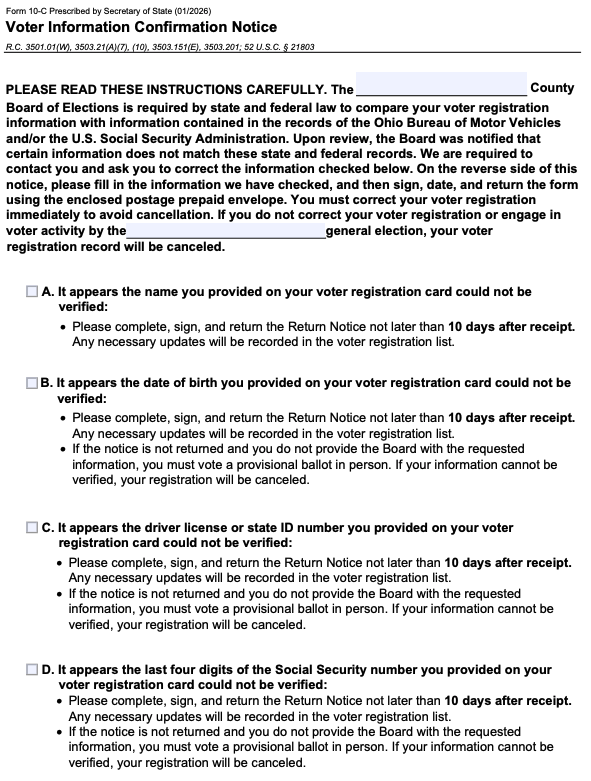
Starting at the May 2026 primary, voters who have been contacted or flagged for having mismatched data between their BMV file and their voter registration, and have not reconciled their data, will not be able to vote by mail. Voters in this scenario will receive this form (also shown below) from the Secretary of State – please fill it out and return at your earliest convenience. These voters will still be able to vote early by going to their County Board of Elections and casting a provisional ballot. After casting a provisional ballot, the voter must return to their Board of Elections by the fourth day after Election Day to provide additional information to have their provisional ballot count.
Provisional Ballot:
Starting at the May 2026 primary, voters who cast a provisional ballot but do not return to their county Board of Elections to provide additional information and “cure” their ballot, will not have their provisional ballot counted and their voter registration will be canceled. A voter may re-register to vote if their registration is canceled for not curing a provisional ballot.