
News & Commentary

Whose Side Are You On? ACLU and Free Speech: Part I
“Freedom of expression is the matrix, the indispensable condition, of nearly every other form of freedom.”
—U.S. Supreme Court Justice Benjamin N. Cardozo in Palko v. Connecticut
The government cannot control individual thought. But if it were to try, its first step would be to limit speech.
The ACLU, as a staunch protector of civil liberties for all, inserts itself into controversies between the government and private groups and individuals. This causes us to be associated with some individuals and organizations with whom we may fundamentally disagree. But we don’t defend these groups because we agree with their underlying message, we defend them because we recognize that when it comes to freedom of expression, their right to express themselves is indivisible from our own.

Disability Rights Ohio calls for Enforcement of Ohio Department of Education Rule on Restraint and Seclusion
By Danielle Gray

How Do We Know if Police Are Obeying the Law?
For years, the story has been the same. Its plot involves unnecessary stops, disproportionate responses, and inexcusable use-of-force. People of color in Cleveland, and cities like it across the country, have become intimately familiar with this narrative. Police enforce the law in different ways depending on who they are policing. And how does this story usually end? With silence from city officials, or maybe a settlement with no admission of wrongdoing. In response to persistent attempts to discredit their experiences, activists and leaders in the black community have pushed for new tools to change how people in power hear their stories. A Similar Story Where Police Collect Data Recently, the court-appointed monitor released a first-year plan for implementing the agreement between the City of Cleveland and the U.S. Justice Department to reform police practices. Several major points in the plan deal with the use of force by officers, and how these incidents are reported. This reporting has the ability to take a disturbingly common story of police misconduct and package it in a way that skeptics cannot ignore. In places where better data collection policies have been implemented, a similar story about inequities in law enforcement emerges. In Florida, a 2005 law began requiring police departments to report the race of people who received seat belt tickets. These numbers revealed massive racial disparities—black people are ticketed for not wearing seat belts anywhere from twice to four times as often as their white counterparts.
By Nathan Cindrich



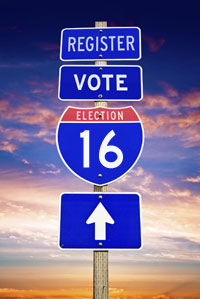
It’s 2016 and everybody’s watching. Get registered Ohio.
Even though our state plays such a huge role in determining the direction of one of the most powerful countries in the world, voters remain disengaged, especially in primary elections. According to data from the Ohio Secretary of State, the average voter turnout in primary elections since 1986 is about 28.55 percent. In Ohio’s last primary in May of 2014, less than 17 percent of voters cast a ballot. Less than one in five people voted. Primary elections are times when parties come together to choose their candidates for the offices which affect our lives the most. These are not just federal offices. Our day-to-day lives are more deeply impacted by what happens in the Ohio General Assembly, on our county boards of commissioners, and in our city and village councils. In so many ways our lives are impacted by the people we elect to lead us, but when selecting these people only a handful of Ohioans actually show up and vote. Frustrated with Government? Speak now. Have you ever been frustrated by how Congress works? You wouldn’t be alone. Approval of the U.S. Congress currently sits at 16 percent. Our elected leaders work for us only when we let them know what we want. This comes in many forms including phone calls, letters, and in-person visits, but the most important indicator of our (dis)satisfaction with their service is the vote that sends or removes them from office. The registration deadline for the March 15 primary election is February 16. You can find all the information you need to register—and even update your registration—on the Secretary of State’s website.
Living With HIV Should Not Be A Crime
By Nathan Cindrich

Stay Informed
Sign up to be the first to hear about how to take action.
By completing this form, I agree to receive occasional emails per the terms of the ACLU’s privacy statement.
By completing this form, I agree to receive occasional emails per the terms of the ACLU’s privacy statement.