
News & Commentary
#YearWithoutTamir Honors Life of Slain 12 Year Old Child
November 23, 2015 marked the one-year anniversary of the death of Tamir Rice, a 12-year old boy shot and killed by Cleveland police while playing in a park near his home. His family and local activists organized several events over the weekend to celebrate his life and to draw attention to the grand jury investigation overseen by Prosecutor McGinty. Vigil Held at Site of Shooting Family members of Tamir, including his Mother and cousin, gathered with the community on Saturday, November 22, 2015 at the Cudell Recreation Center, where Tamir Rice was shot by police Officer Timothy Loehmann one year ago. Concerned members of the community met to honor Tamir’s life and to demand accountability from Officer Loehmann. A group of young children, surrounded by stuffed animals and small presents for Tamir’s memorial, faced members of the community who released 12 doves into the sky, one for each year of Tamir’s life. During this time, attendees observed a moment of silence. Everyone in attendance extended their deepest sympathies to Samaria Rice, Tamir’s mother, on the 1-year anniversary of her child’s death. The message of the vigil was clear: stop killing our children. 200,000 Signatures Delivered to McGinty On Sunday, November 23, 2015, members of the community marched to Prosecutor McGinty’s office in a peaceful demonstration to deliver 200,000 signatures, with names from all over the country, in a petition organized by Color of Change, Change.org, and Showing Up for Racial Justice. The petition calls for McGinty to step down and to be replaced by a special prosecutor.
By Avery Martens

When Protecting Liberty Means Defending Your Enemy
"What if someone were to kill you!” This is one of the more common threats yelled at me and my fellow clinic escorts when we volunteer at Cleveland’s Preterm Abortion Clinic. Such terrorizing phrases come from a group of self-identified “pro-life” protesters, who wait outside the clinic daily to voice their dissension towards and disrespect for the clinic’s staff, volunteers, security guards, patients and women in general. They tell us that anyone associated with a clinic that provides abortions is evil. They are not interested in a discussion about what is constitutional, what promotes women’s health, or what is scientifically accurate. We have seen them celebrate when they see they make a patient cry. But as long as they do not occupy private property or physically harm anyone, they have a right to protest. Their judgmental protests – often crude and vulgar -- are protected under our county’s Constitution, the charter of our nation that the ACLU defends. The Supreme Court of the United States has ruled repeatedly that the First Amendment guarantees freedom of expression, which means the government cannot interfere with the right to protest, the freedom of the press, or religious liberty.

Ending De Facto Debtors’ Prisons in the United States
This piece is also featured by the Vera Institute. John and Sam were trapped in a vicious cycle of incarceration. When money was scarce, John would make Sam’s court payment instead of his own so she could stay out of jail and care for their child. It was a heartbreaking choice that he made more than once. John has been incarcerated four times for failure to pay fines and costs—each time for 10 days. Even though John and Sam were on the brink of homelessness, the court never asked about their financial ability or offered an alternative to payment. This is modern day debtors’ prison.
By Jocelyn Rosnick

A Call for Justice: ACLU of Ohio’s Pay-to-Stay Press Conference
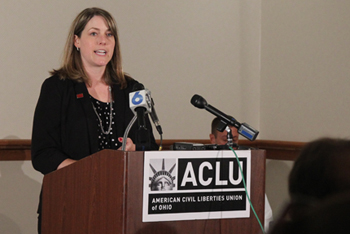
ACLU of Ohio regional director Adrienne Gavula addresses the press and opens up the event.
ACLU of Ohio senior policy director Mike Brickner speaking about the predatory practice of pay-to-stay fees
"We can’t hope to balance our budgets on the backs of low income people. First of all, it’s bad policy but second of all, it just won’t work. These people can’t pay and when we force them to and when we put up barriers, we make it harder for them to actually be successful and we only hurt ourselves and our community."
Reporters listen as Brickner explains the cyclical trap many Ohioans are snared into after being charged pay-to-stay fees.
By Lauren Lynch-Novakovic

Discrimination Against LGBT People is Still Legal in Ohio
Most people don’t realize that Ohio has no laws protecting people from being fired from their jobs, denied housing, or refused service simply for being LGBT.
By Nathan Cindrich
Ohio Must Stop Executions of People with Severe Mental Illness
The American Civil Liberties Union of Ohio supports a bipartisan bill which seeks to spare those with severe and persistent mental illness from facing execution in the state of Ohio. This bill came out of the Ohio Supreme Court Task Force, which recommends an end to this barbaric practice. Cruel and Unusual In 2002, the U.S. Supreme Court declared it unconstitutional to execute someone deemed mentally incompetent due to a diagnosed intellectual disability (formally referred to as mental retardation). This ruling paved the way for a 2005 U.S. Supreme Court decision that declared it unconstitutional to execute people who were minors at the time of their crime. Both decisions reflect an understanding of the Eight Amendment to the U.S. Constitution which prohibits cruel and unusual punishment. Just as with youth and those with a diagnosed intellectual disability, people with a severe and persistent mental illness lack the culpability required to receive a death penalty sentence. In other words, it is cruel and unusual punishment to put someone to death who does not or did not have the capacity to understand their crime or what their punishment means. Equal Protection for All Supporters of banning the execution of individuals with severe and persistent mental illness also cite the 14th Amendment to the U.S. Constitution, which promises “equal protection and due process” under the law. Individuals with severe and persistent mental illness are not receiving equal protection by the same bans that acknowledge diminished capacity and substantial impairment for individuals with intellectual disabilities. This right should apply to whomever experiences significant, diagnosed, diminished mental functioning as a result of any psychological disability.
By Avery Martens

The Ohio Constitution Shouldn’t Define Anyone as an “Idiot” or “Insane Person”
The lack of procedure for determining who is “insane” or an “idiot” could allow persons whose opinions are unpopular or whose lifestyles are disapproved to be challenged at the polls, and they may lose their right to vote without the presentation of any medical evidence whatsoever.[1]
For reasons that are not clear, the General Assembly did not present this issue to voters. It remains a section of our constitution that is not only problematic because of the way in which it uses pejorative terms, but also because of its vagueness. This provision could be used to disqualify any voter whom poll workers deem incompetent.
During the meeting this past Thursday, 11 November 2015, University of Akron School of Law Emeritus Professor Wilson Huhn testified on behalf of the ACLU.
Read Professor Will Huhn’s testimony to the Constitutional Modernization Committee.

Prison Overcrowding Won’t Fix Itself
In Ohio, we have a problem with prison overcrowding. As a recent Department of Justice Report shows, Ohio's prison population ranks sixth among all states. Last year, Ohio only managed to reduce its prison population by 0.4%, which is exactly 210 people. In a state that currently locks up 11,854 more people than our prisons and jails are designed to house, that reduction is in no way adequate. Why does Ohio continue to have this problem? Why have our prisons been overcrowded for more than a decade? One factor is enhanced sentencing bills appearing in the Statehouse. Making a Tough Problem Harder to Solve According to a recent report by the ACLU of Ohio, the Ohio legislature continues to introduce bills that enhance criminal sentences, create new crimes, and extend the scope of current laws to cover new people and situations. These are bills that aim to incarcerate more people for longer periods of time. This legislative session alone, our representatives have introduced 54 new bills that will send more Ohioans to prison or jail.
By Nathan Cindrich

Stay Informed
Sign up to be the first to hear about how to take action.
By completing this form, I agree to receive occasional emails per the terms of the ACLU’s privacy statement.
By completing this form, I agree to receive occasional emails per the terms of the ACLU’s privacy statement.