
News & Commentary
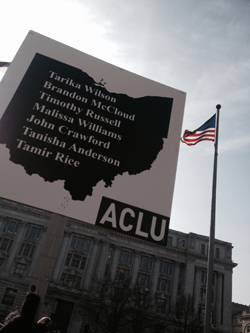
Black Lives Matter: Policing, Indifference, and Women of Color
Photograph courtesy of Rachel Woods

Corrections Corporation of America's Loss is Ohio's Gain
What happens when a prison for profit loses one of its main moneymakers? We’re about to find out. The federal Bureau of Prisons announced last week that they would not renew their contract with Corrections Corporation of America to house prisoners in the Northeast Ohio Corrections Center in Youngstown. The facility houses nearly 1,400 prisoners that will be transferred to other federal prisons. Given CCA’s abysmal track record at the Youngstown facility, it is no wonder that the BOP decided they no longer wanted to be in business with them. When the prison opened in 1997, CCA staffed the prison with officers who had little to no experience in corrections and then populated it with 1,700 high-level prisoners from Washington, D.C. Within the first 14 months, the facility experienced 13 stabbings, two murders and six escapes. Youngstown officials feared so much for the safety of residents that they sued CCA in federal court for failing to abide by its own standards. The judge in the case agreed and ordered CCA to remove 113 of the maximum security prisoners from the facility.


2016 Is Only a Year Away...
Read our previous blogs on the more recent Ohio protests, "Fallout from Ferguson: Takeaways from Two Ohio Protests," "Black Lives Matter: Marching on Washington," and "Survival Conversations."
The third step is sustaining the energy to demand accountability. If we are not vocal about a particular issue, then the public official does not know we need change. Furthermore, that public official may think we are not paying attention. Accountability must be a two-way street: the public demands and the official reacts.
The start of a New Year is a time for reflection and celebration. Let us do just that—reflect and celebrate—but keeping in mind that 2016 is going to be a big year for Ohio.
Happy New Year!
For more information about protesting peaceably, check out “Protestors: Know Your Rights!” and “What to Do if You're Stopped by the Police.”

Civil Liberties in Ohio: Top Priorities for 2015
» Safeguard the freedom of speech to ensure that our rights are not chilled and individuals can feel empowered to exercise their rights. We stand ready to combat SLAPP (strategic lawsuits against public participation) suits aimed to suppress individuals from speaking out on issues of public concern.
Achieving Success for Ohioans
Help us fight for our freedoms. Donate today!
In defending civil liberties, we have many challenges ahead of us.
Our goals require a strong ACLU that has the resources to defend freedom on all fronts. With your help, we can fulfill our aspirations for 2015 and much more.

Celebrate the Holidays, But Don’t Let the Government Pick Favorites
For more information, read "Civil Liberties and the Holidays."
The First Amendment also provides a second aspect of religious liberty: that the government may not establish a religion. Courts have come to accept that this means that officials cannot favor one religion over another or favor the right to worship over the right not to worship. What this means in the context of holiday displays is that government officials may not use taxpayer dollars or public land to erect a display that favors a single religion.
This is the part where those pundits start to fume, claiming that nativity scenes, crosses, and other religious displays have been a community tradition for years and that to forbid such a display is a violation of religious liberty.
However, as we are all allowed to post whatever religious symbols we would like on our own private property, how exactly are our religious rights being violated?
One only has to take a short walk through downtown areas in Northeast Ohio and all over the state to see that cities are decorated for the season. Most towns have displays that feature all sorts of holiday characters like Santa Claus an

Stay Informed
Sign up to be the first to hear about how to take action.
By completing this form, I agree to receive occasional emails per the terms of the ACLU’s privacy statement.
By completing this form, I agree to receive occasional emails per the terms of the ACLU’s privacy statement.